
Please help me for a moment.
I’m so sheltered that not only did I not learn that Eli Whitney–this guy:
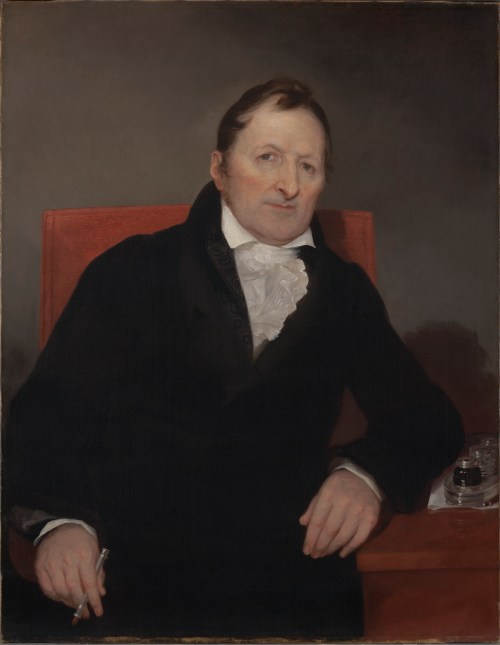
was Actually Black, I didn’t even know that learning that Eli Whitney Was Actually Black was a thing. But apparently, per Buzzfeed and Slate, there are apparently a whole bunch of people who made it through school (at least until they got to college) believing that Eli Whitney, who, again, looked like this:
was a black man. So I guess what I’d like to know is, uh, what the fuck is going on here? Are K-12 teachers actually teaching students that Eli Whitney
was black, or are we witnessing some kind of mass hallucination or collective descent into madness? I mean, look at that guy! Even if he hadn’t invented a device that significantly worsened the already horrific American slave experience, if you go by that portrait up there he’s almost as white as his puffy pirate shirt. Are there other people in American history whom we’ve collectively decided to misremember like this? Was James Madison actually a very tall man? Was Abraham Lincoln actually three short guys standing on each others’ shoulders? Did Herbert Hoover actually invent the vacuum cleaner after all?
Are my descendants going to someday learn that Steve Bannon was black?
HA HA HA, of course not; humanity isn’t going to survive long enough to remember Steve Bannon at all.
Anyway, I don’t have much of a point here, but Slate’s Ruth Graham suggests that the story of Eli Whitney
is so intertwined with the story of slavery that somehow he winds up being identified as black because students first learn about him in that context:
For one, Whitney’s invention was so tangled up in African-American history that it is often taught during Black History Month in elementary-school history classrooms and other sites of popular history. Patented in 1793, the cotton gin turned a labor-intensive crop into an extremely profitable one, boosting the demand for slave labor. Between 1790 and 1860, the number of slave states grew from 6 to 15, and the slave population more than quintupled in the same period. A Florida newspaper’s 1994 bullet-point list of “How black Americans helped shape the Sunshine State,” for example, has one entry that reads “1793: Eli Whitney’s cotton gin leads to increased importation of slaves to work on cotton plantations.” It’s not claiming Whitney was black, but it’s understandable how a casual reader could interpret it that way.
She even apparently found people who think that the name “Eli Whitney”
sounds black, which…well, to each his/her own, I guess. It seems like a pretty generic name to me.
Going further, she suggests that the irony of a black man inventing something that made life worse for other black people is too powerful for people to pass up even though in this case the man in question, Eli Whitney
wasn’t, you know, black. I would argue there’s a bit of subconscious white apologia at work there, too, the same tendency that caused my dearly departed and good-hearted grandmother to watch the film Amistad and say afterward, “I can’t believe those Africans did that to each other.” If Eli Whitney
really had been a black man, well, that might absolve white people of just a tiny bit of guilt with respect to the slave experience, and that comforting feeling probably helped this alternative fact catch on.
Anyway, if you actually remember learning that Eli Whitney
OK, you get the point
was a black man, please talk about it in the comments.
Hi, how’s it going? Thanks for reading; attwiw wouldn’t exist without you! If you enjoyed this or any other posts here, please share widely and help build our audience. You can like this site on Facebook or follow me on Twitter as well. Most critically, if you’re a regular reader I hope you’ll read this and consider helping this place to stay alive.


