
Hey, Abu Bakr al-Baghdadi is dead! Well, maybe, I mean. U.S. airstrikes on al-Qaʾim, Iraq, on Sunday reportedly “seriously wounded” or possibly even “killed” the erstwhile Caliph Ibrahim, though it should go without saying that reports like these are the definition of sketchy and shouldn’t be given too much weight without reliable confirmation. He’s definitely either alive or dead, though, you can be sure of that, I guess.
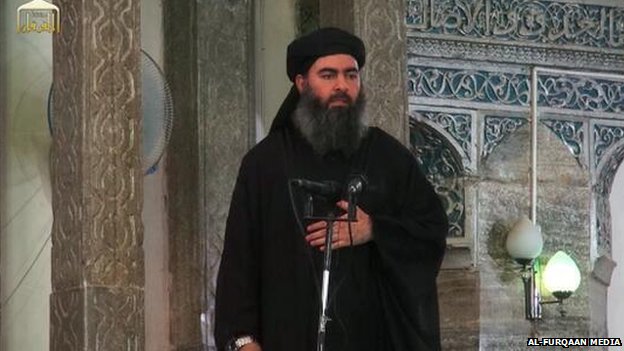
Still, even if Baghdadi survived the weekend and is still among the living today, he’s in a line of work where folks tend not to live too long, by which I mean “leader of a terrorist network” and not “caliph,” although plenty of “caliphs” had short lifespans too, I suppose. It’s not out of bounds to take the opportunity of his rumored death and/or serious injury to speculate about whether his actual death would be a serious blow to his organization.
So does Baghdadi’s death matter, or would it if he actually were dead?
I mean, Baghdadi seems like a pretty capable leader. ISIS, or Al Qaeda in Iraq as it was known before he took over, was almost out of commission when he took it over in 2010. Baghdadi rebranded the organization away from the discredited AQI label and turned it from a mostly foreign mujahideen group into a mostly Iraqi one, which boosted its credibility and allowed it to reemerge as part of the wave of Sunni resistance to Nouri al-Maliki’s discriminatory policies in Baghdad. He also helped raise the money that kept the group going until it could sustain itself as it does now. Though Bahgdadi is apparently not much of a battlefield leader and his fundraising ability is no longer that important to the group, he’s the one who’s been holding the movement together (alongside its mostly secular former Baathist allies) and it’s his image as “caliph” that has been bringing in new recruits. It would be a mistake to discount his importance to ISIS.
On the other hand, I agree with what The War Nerd has been saying for a while now: we’ve probably already seen Peak ISIS no matter who is in charge. After a string of rapid conquests in Iraq and successes against Bashar al-Assad’s army in NE Syria, ISIS’s progress has pretty clearly flattened out or even reversed itself. They’ve failed to take Kobani, they’ve failed to put any more pressure on Iraq’s Kurds, they were flat-out beaten at Jurf al-Sakhar in Iraq, and the U.S. airstrikes, for which they’ve got no answer whatsoever, just keep coming. They’ve reached more or less the extent of the territory they could easily control without bumping up against large, hostile populations of Kurds and Shiʿa who aren’t swayed by ISIS’s propaganda and will actively resist their advance. Plus, you know, the airstrikes. It’s hard to overemphasize how devastating those can be, in terms of both the material reality and group morale, when you’ve literally got no way to respond to them. So a miraculous Baghdadi recovery probably can’t reverse ISIS’s military situation, which is pretty bleak if you’re a fan of nihilist psychopathic misfits misappropriating medieval imperial trappings. That’s not to say that ISIS can’t stay entrenched where it already is for a while, or that there isn’t a lot of work left to do to really degrade their capabilities, but the group’s days as an expansionary power may well be over.
In fact, it’s entirely possible, as The War Nerd suggests, that whoever succeeds Baghdadi when he eventually does shuffle off the planet will actually be able to reverse his biggest mistake, which was declaring his guerrilla paramilitary movement a “state” and then a “caliphate” in the first place. Paramilitary fighters can disappear, go to ground and blend back into the population, when times get rough, then resurface when circumstances are more favorable. Wanna-be empires don’t have that luxury. They have to take and hold territory, to tax and police and provide public services to their “subjects,” and above all they have to keep winning, otherwise the whole imperial ideology falls apart. If Baghdadi is followed by somebody who gets that, and brings ISIS back from the difficult place to which Baghdadi has led them, then his death could actually be bad news for those of us who aren’t fans of nihilist psychopathic misfits misappropriating medieval imperial trappings. The fact that ISIS’s top echelons seem to be filled with veterans of Saddam Hussein’s military would suggest that this is a plausible scenario. Juan Cole is right when he notes that “there are plenty more potential ISIL leaders out there.”

 The Foreign Exchanges Companion
Well put.
It’s interesting, the idea that declaring the idea of a state is creating problems for Baghdadi. I’d always understood the idea of the caliphate or the ISIS state as a concept, rather than a human reality on the ground, but of course, you’re right. There comes a point where ISIS would have to run the populated territory that they’ve conquered and there aren’t enough of them to keep a heavy dictatorship going for any length of time. They don’t seem to be recruiting bureaucrats, accountants, lawyers or administrators, do they? Not in the UK, anyway.
Bureaucrats can be adopted from the previous administration (that’s the way the OG caliphate did it), and especially in Iraq there’s no shortage of former middle-management types who lost their jobs in the de-Baathification purge. But ISIS seems to be clearly administering the territories under its control as any other governing body would: social services, utilities provision, taxation, policing, etc. If they weren’t, they wouldn’t be able to make a case to the people under their control that their governance is preferable to Damascus or Baghdad.
I had thought their case was made down the barrel of a gun. I had no idea they appear to be a preferable, more efficient form of governance to those who don’t sympathise with them.
It’s not an appeal to those who don’t sympathize with them, but to those who might be inclined to sympathize with them as the least bad option. ISIS is awful, but so is Assad and so was the last few years under Maliki if you’re an Iraqi Sunni. They can make an argument to the people living under their control that they are better than what they replaced.