
I need your help to keep this blog going! Please read this and consider contributing something. Also, while you’re out there on the internet tubes, please consider liking this blog’s Facebook page and following me on Twitter! And please share my work with your friends/followers to help me grow the audience around here! Thank you!
Many (all?) of the various wars currently raging in the MENA zone (Syrian rebels vs. Assad, Yemeni Houthis vs. Hadi, the Libyan civil war, everybody vs. ISIS, etc.) have taken the form of proxy wars to some extent. Both Libyan factions are backed by rival Gulf states. Saudi Arabia is backing Hadi with men and air power in Yemen against the Houthis, who are–sort of–Iranian clients. Syria’s civil war has drawn in so many outside actors that the first round in the most recent attempt at peace talks didn’t actually involve anybody from Syria. And the war against ISIS has involved proxies. The United States has sent trainers and equipment to work with Syrian Kurds, Turkey has been helping Syrian Turkmens and Iraqi Kurds, the Iraqi government has been relying on militias when its own army wasn’t up to the task, and so on. You get the idea.
The problem with trying to fight a war by proxy–well, one of the problems–is that proxies aren’t unthinking automatons who will do what you want and never go beyond that. It’s a give and take relationship, and sometimes, as in the now-infamously failed American “train and equip” program in Syria, the relationship falls apart because one side tries to take too much or isn’t willing to give enough. But other times, the proxy relationship holds but leads one or another of the parties to an extremely bad place. For example, Iraqi Kurds and Shiʿa Arabs may have believed they had become American proxies after the Gulf War, when American rhetoric seemed to be encouraging them to take action to overthrow Saddam Hussein, but when the US proved unwilling to risk Iraq’s territorial integrity by backing their respective uprisings, they wound up being slaughtered by the Iraqi army.
The sponsor-proxy relationship can work to the detriment of the sponsor as well, and we’re seeing examples of that in Syria and Iraq right now. In Syria, the Kurdish YPG, a major American client because it’s one of the few factions in that country that prioritizes fighting ISIS, has been systematically destroying Arab towns and displacing Arab residents in territory they control. The YPG claims it’s only driving out suspected ISIS sympathizers, but this is a group that’s trying to carve out a Kurdish enclave in northeastern Syria, and what they call “driving out suspected ISIS sympathizers” looks suspiciously like ethnic cleansing to outside observers. These actions are war crimes, but aside from the moral issue they’re also a strategic problem for the United States, because those displaced Arabs are prime recruitment fodder for ISIS or other extremist groups that promise to fight the YPG. American support for the YPG discredits America in the eyes of people (Sunni Arab Syrians) we need on our side in the fight against ISIS.
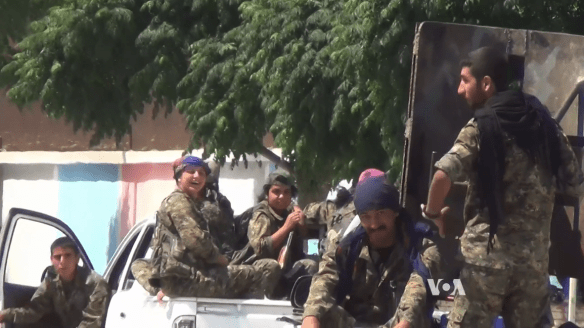
You can practically hear people in Ankara shouting “WE TOLD YOU SO” at the reporting of YPG war crimes. But Turkey has the same problem on its hands. Iraq’s Kurds, supported by both the US and Turkey, are reportedly preventing displaced Arabs from returning to territory that’s been regained from ISIS and are destroying Arab property and towns. This, again, is a war crime (the definition doesn’t change from country to country). Iraqi Kurds have made the same security argument that the YPG has made, and they’ve also blamed the destruction of Arab property on ISIS “boobytraps.” But, as in Syria, it all looks a little too much like ethnic cleansing for comfort.
Then there are those Iraqi Shiʿa militias, the ones that Baghdad can’t live with but also can’t live without. The militias were mostly sidelined in the fight to reclaim Ramadi, after they’d made a thorough mess of the liberation of Tikrit by targeting Sunni residents and their property for looting and destruction. But in Iraq’s eastern Diyala province, they’ve been quite active and quite harmful to Baghdad’s long-term interests:
Shi’ite militiamen deployed this month in Muqdadiya, 80 km (50 miles) northeast of Baghdad, after two blasts killed 23 people near a coffee shop where they often meet. Islamic State claimed responsibility for the attacks which it said had targeted Shi’ites.
New York-based HRW said members of the Badr Organisation and Asaib Ahl al-Haq, leading groups in the government-run Popular Mobilization Forces fighting Islamic State, were responsible for retaliatory attacks it described as “serious violations of international humanitarian law”.
ISIS was driven out of Diyala last year, but obviously it remains capable of carrying out attacks there just as it can in Baghdad. The Iraqi government has allowed Badr to establish itself as Diyala’s unofficial police force–or occupying army, depending on your point of view–and their repeated brutality toward the province’s Sunni Arabs constitutes the same kind of war crimes the Kurds have been committing in the north. Here the impetus may be more about taking revenge against Sunnis who are perceived to be ISIS’s people than about actual ethnic (or religious) cleansing, but the end result is the same. And again, apart from the moral atrocity, this is supremely harmful to any sustainable anti-ISIS strategy, which must bring Iraq’s Sunni Arabs on board and leave them feeling like they’re full-fledged citizens of a pluralistic Iraq.
It seems pretty clear that Iraqi Prime Minister Haider al-Abadi understands this, but it’s not at all clear that he can do anything about it. He’s got to focus as much military attention as he can on the fight against ISIS in Anbar and the eventual campaign to retake Mosul, which is why a group like Badr is able to have so much autonomy in Diyala in the first place. It doesn’t help that oil is currently selling at prices far below what Baghdad needs just to break even, let alone to do something proactive like train a new police force for Diyala. Abadi’s job would be easier if he had the resources with which to do it.

 The Foreign Exchanges Companion
