
For a change, let’s start today with a story that isn’t about people killing other people or crazy people running for office, OK? The Turkish government has nominated the Stone Age site of Göbekli Tepe, located in Turkey’s south-central Şanlıurfa Province, for a spot on the UNESCO World Heritage List. Archeological work has been done on the Göbekli Tepe site since the 1960s, but it’s only in the past 3 decades that heavy digging has been done there, and it has unearthed what appears to be a remarkable Neolithic find:
An information sheet the Culture and Tourism Ministry provided to Al-Monitor contains the following information: “Two 5-meter-tall [16 feet], T-shaped limestone pillars stand encircled by 20 round and oval structures of up to 30 meters [98 feet] in diameter. In the interior walls of those structures, there are smaller pillars. The scientific data from Gobeklitepe contains major findings that require a re-evaluation of the theoretical framework and datings in archaeological studies of the Neolithic period. Based on Gobeklitepe’s location and size, the carbon-dating performed there and the monumental character of the structures, it is understood that the area is a unique Neolithic cult site. The area, which remained untouched for 12,000 years in its natural environment, has provided significant archaeological findings.”
The pillars at the site feature carvings of animals — scorpions, foxes, snakes, boars, lions, cranes and mallards — as well as plants and abstract symbols. The temple predates Stonehenge by 7,000 years, the Egyptian pyramids by 7,500 years and the first Mesopotamian cities by 5,500 years.
This is what appears to be a temple complex that was built 12,000 years ago, which means it predates civilization itself, in that it was in existence prior to the earliest known cities. The idea that pre-settled, pre-agricultural societies were capable of creating monumental architecture and art challenges everything that scholars thought they knew about the development of civilization and its early relationship with organized religion:
The temples thus offer unexpected proof that mankind emerged from the 140,000-year reign of hunter-gatherers with a ready vocabulary of spiritual imagery, and capable of huge logistical, economic, and political efforts. A Catholic born in Franconia, Germany, Schmidt wanders the site in a white turban, pointing out the evidence of that transition. “The people here invented agriculture. They were the inventors of cultivated plants, of domestic architecture,” he says.
That last part is literally true, since genetic testing suggests that the earliest domestication of wheat could have happened in Göbekli Tepe’s immediate vicinity in the centuries after this site was first built. Organized religion, it turns out, may actually be older than agriculture, a notion that, if true, requires a fundamental rethinking of human prehistory. This could literally be the oldest monumental site ever built by human beings, or at least the oldest such site to survive more or less intact into the present day.
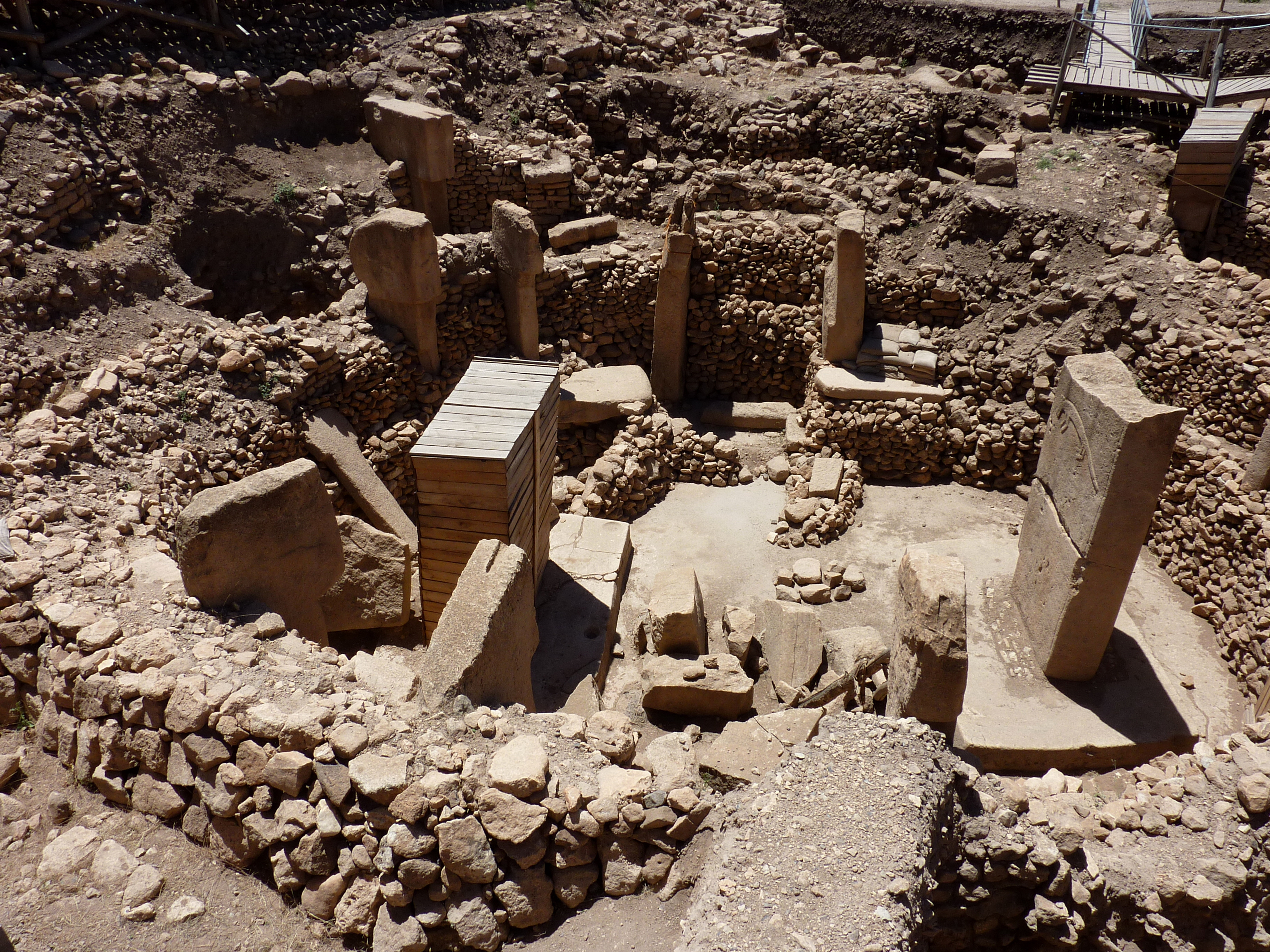
Göbekli Tepe’s remarkable uniqueness as a site actually works against its influence on academia. Scholars are half-expecting a village to be discovered nearby, or to find out that the site has been mis-dated. They can’t explain how the site was built or what the artwork means, or why it eventually stopped being used, and as long as major questions like that remain unanswered it’s hard to make a lot of sweeping judgments about the site. Getting the site on the World Heritage List could help support further study there as well as efforts to make it suitable for tourism, like building an on-site museum.
Hey, thanks for reading! If you come here often, and you like what I do, would you please consider contributing something (sorry, that page is a work in progress) to keeping this place running and me out of debtor’s prison? Thank you!

 The Foreign Exchanges Companion
.JPG#/media/File:G%C3%B6bekli_Tepe_site_(1).JPG)