
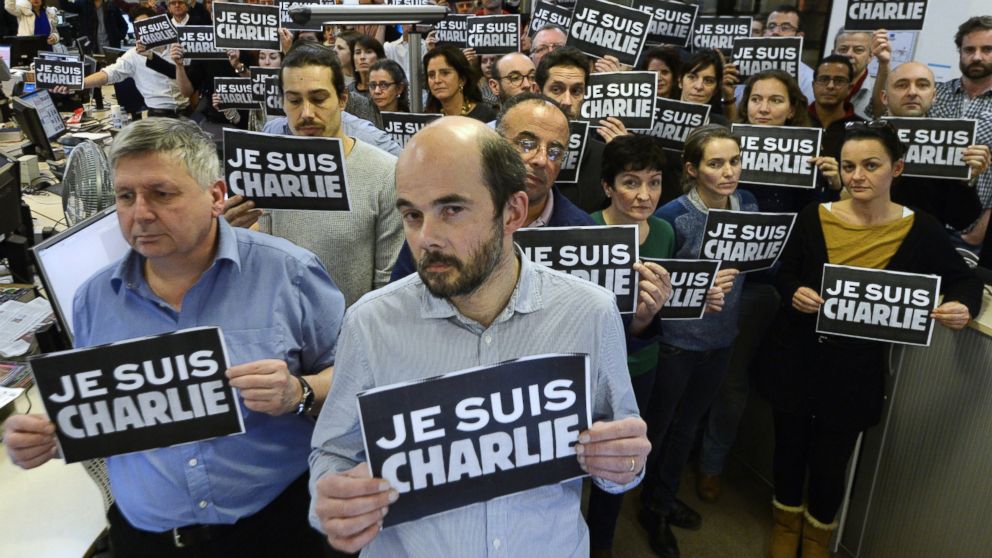
I was away from the blog yesterday (and most of today, for that matter; that’s what happens when they cancel school and you have a car that needs a new battery) when news broke of the unspeakable terrorist attack on the offices of the satirical French newspaper Charlie Hebdo. I’m not sure I could have written anything of value if I had been here. There’s only so many ways you can express revulsion when man’s inhumanity to his fellow man is unleashed, and it seems like we’ve been on quite a run of that sort of thing of late. As I write this, two of the suspects in the attack are still at large and still terrorizing people, while one of them has turned himself in to authorities.
Much of what I had to say about the Man Haron Monis attack in Sydney applies to this attack as well:
The ultimate goal for organized groups like Al Qaeda and ISIS is to weary Western nations to the point where the people of those nations demand withdrawal from the Middle East altogether. But in the meantime, and especially for lone nuts like Monis, these attacks are about getting those societies to do the terrorists’ work for them, about manipulating them into actions that boost the jihadi movement and diminish the principles upon which those Western nations claim to be based. The 9/11 attack wasn’t a victory for Al Qaeda in and of itself — for a while, in fact, when the United States limited itself to a focused retaliation against Al Qaeda and the Taliban, it looked like 9/11 might prove to be a major mistake. What made 9/11 successful for Al Qaeda was what came next: the decision to invade an unrelated nation without justification just because we needed to lash out, the decision to wad our supposed principles up into a ball and toss them on a bonfire because we needed to Protect the Homeland, the continued decisions to engage in acts that create more terrorists than they eliminate, and so on. It was our counterpunch, our wild, flailing counterpunch, that gave Al Qaeda exactly what it wanted, and then some, when it conceived of the 9/11 plot in the first place.
Juan Cole made a similar point yesterday, albeit with a lot more flair than I managed:
The problem for a terrorist group like al-Qaeda is that its recruitment pool is Muslims, but most Muslims are not interested in terrorism. Most Muslims are not even interested in politics, much less political Islam. France is a country of 66 million, of which about 5 million is of Muslim heritage. But in polling, only a third, less than 2 million, say that they are interested in religion. French Muslims may be the most secular Muslim-heritage population in the world (ex-Soviet ethnic Muslims often also have low rates of belief and observance). Many Muslim immigrants in the post-war period to France came as laborers and were not literate people, and their grandchildren are rather distant from Middle Eastern fundamentalism, pursuing urban cosmopolitan culture such as rap and rai. In Paris, where Muslims tend to be better educated and more religious, the vast majority reject violence and say they are loyal to France.
Al-Qaeda wants to mentally colonize French Muslims, but faces a wall of disinterest. But if it can get non-Muslim French to be beastly to ethnic Muslims on the grounds that they are Muslims, it can start creating a common political identity around grievance against discrimination.
The overreaction is the goal. Provocation is the point. The way to defeat Al Qaeda and groups like it is not to take the bait. Unfortunately, we almost always take the bait, and this case doesn’t seem like it will be any different, neither in the immediate aftermath nor in the long term. Paradoxically, though I find a lot of their cartoons offensive (see below), the people at Charlie Hebdo, including those so unjustly murdered yesterday, seem to have gotten that the best response to Islamic extremism, to all extremism really, is to treat it as the ridiculous joke that it is. When you lash out against extremists in anger, hatred, or fear, you end up justifying their extremism and boosting their cause. Yes, terrorists and terrorist groups like the ones responsible for yesterday’s attack (which seems at this point to have been at least inspired by Al-Qaeda in the Arabian Peninsula) must be defeated through police and military means, but the ideology that underpins their work cannot be legitimized in the process, or else the fight will never end.
Below, a few thoughts about Charlie Hebdo and freedom of speech.
One thing that separates the Charlie Hebdo attack from the Monis attack (apart from geography and what appears to be a higher level of sophistication on the part of the attackers in Paris) is that Charlie Hebdo wasn’t a randomly chosen target as (presumably) the Martin Place Lindt Chocolate Cafe was. The newspaper’s stock in trade is the satirical cartoon, and it’s fair to say that they’ve pushed right up to and over the “offensive” line on many occasions when it comes to…well, lots of people and groups, but including, and maybe especially, Muslims. It’s clear from witness reports that the attackers had targeted Charlie Hebdo deliberately for retaliation (the gunmen were heard to say “We have avenged the Prophet Muhammad” during the attack). This has led some to treat this particular incident as an attack on free speech itself, which seems hyperbolic, although I suppose it’s never a bad thing to remind ourselves that freedom of speech is a Good Thing that must be protected. That said, I would like to offer my two cents on this point:
- it is, contrary to some of the more extreme anti-Islam elements (I wouldn’t click on that link unless you really want to check my work) out there, possible to condemn this attack and all attacks like it categorically, to believe deeply in the value of free speech, and also to think that Charlie Hebdo‘s anti-Islam cartoons were frequently in poor taste in a crass, “punching down” kind of way (which is why the “hey, they satirize everybody” response rings hollow; “everybody” isn’t as marginalized in French society as France’s Muslim minority)
- virtually nobody who is asking questions about the value of what Charlie Hebdo was doing with its anti-Islam cartoons, outside of a small, radical, ugly fringe, is apologizing for or condoning yesterday’s attack, nor are they saying that Charlie Hebdo shouldn’t have been allowed to publish those cartoons; if you read any piece that argues otherwise, check for piles of straw and be careful with any open flames
- that said, right now might not be the best time to offer your “Charlie Hebdo was actually bad” hot take, assuming you really want to contribute to a dialogue about how elite institutions contribute to the marginalization of out groups and you’re not just out to stir shit up
UPDATE: Matt Yglesias is right on the money:
Cartoons depicting Mohammed in an unflattering light have become a flashpoint for free speech in Europe. Murdered cartoonists have become martyrs. People cannot, realistically, simply respond by resolving to be polite in the future.
But rather than exulting in this, we ought to find it regrettable. The fact of the matter is that racist and Islamophobic attitudes are a huge problem in the everyday lives of Europe’s Muslim population. Far-right political parties are on the rise, and mainstream parties are moving to co-opt their agendas. Blasphemous, mocking images cause pain in marginalized communities. The elevation of such images to a point of high principle will increase the burdens on those minority groups. European Muslims find themselves crushed between the actions of a tiny group of killers and the necessary response of the majority society. Problems will increase for an already put-upon group of people.

 The Foreign Exchanges Companion