At Al Jazeera, Michael Pizzi asks:
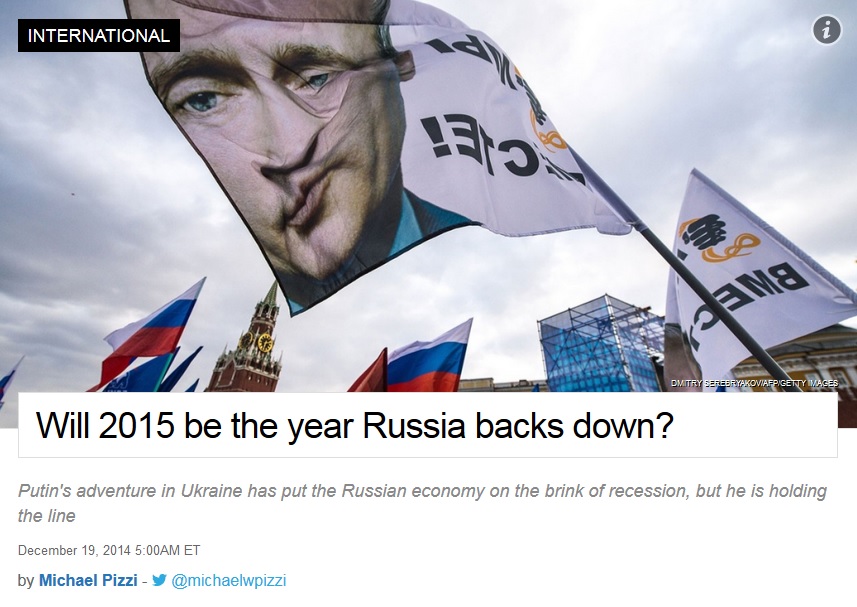
No. Well, I hate talking in absolutes about the future, so let’s go with “most likely not, at least not without some conciliatory moves by the West.”

Pizzi makes a good case for why almost anybody else would back down in Putin’s situation:
But the collapse of the ruble will put him under pressure at home in the early months of 2015. Russians are reportedly swarming automobile dealers and foreign retailers like IKEA, hoping to cash out before the currency devalues further. Putin has shrugged off questions about the economy, saying he has a plan to fix it, though he did not specify what it is. If public support begins to slip, Putin could try to seek a face-saving compromise in Ukraine. As Romanov puts it, “they can endure great difficulty, but Russians are not masochists.”
Russia’s economy, which has been teetering for a while now as the situation in Ukraine and the related Western sanctions imposed on Russian banks and businessmen have caused foreign investors to start pulling out of Russia, has officially collapsed, at least if you go by Wonkblog’s Matt O’Brien, thanks to the sharp drop in oil prices. Russian banks project the economy will shrink at least 4.5% next year if oil stays around $60/barrel. Russia’s central bank just jacked up interest rates to try and salvage the value of the ruble, an attempt that failed miserably and left the country with higher interest rates and a currency that’s still only worth about half what it was worth in July. At this point they’re probably in an inflationary cycle, where high inflation further weakens the economy, which causes more inflation which further weakens the economy, which causes more inflation and on and on. Because of the sanctions, the Russians can’t get an emergency loan from Western banks, and O’Brien is surely correct when he says that they won’t go to the IMF for a bailout because the IMF will insist that they stop whatever they’re doing in eastern Ukraine and maybe also in Abkhazia. Worse, the Russian government just today announced that it was bailing out its banks to the tune of billions of dollars, because the banks are no longer apparently able to obtain foreign currency with which to pay back their foreign loans.
Seems like this would probably be a good time to stop doing those things anyway and go get some financial help. But you’d actually be on firmer ground predicting that Putin will keep on keeping on or even escalate things in 2015, because he’ss never been shy about asserting himself when times get rough. I don’t want to sound like I’m picking on Pizzi, who concludes that it’s equally likely that Putin will step up, rather than back down, in Ukraine just to break out of the current situation. But here’s Max Fisher at Vox, running through Putin’s response to Russia’s last economic downturn, which culminated in protests in 2012 on the eve of Putin’s return to the presidency:
That meant ginning up conflict with the US, for example by banning American families from adopting Russian orphans, and seizing on geopolitical crises such as Syria as an opportunity to present Russia as a great power opposed to nefarious Western imperialism. It also meant cracking down on free speech and civil rights at home, cracking down on everyone from journalists to gay and lesbian people, while ratcheting up nationalistic propaganda in the media. And, ultimately, it meant invading Ukraine, which Putin presented as a humanitarian intervention to save fellow Russian-speakers from evil Western fascism.
All of this worked: it distracted Russians from the sinking economy, focusing them instead on perceived enemies at home and abroad: Ukraine, the West, Russian liberals, Russian gays and lesbians. In fact, Putin’s approval rating even rose, to a meteoric high of over 80 percent. But the danger is that Putin became trapped in the logic of his own propaganda, which is a big part of why he invaded Ukraine again, this time in eastern Ukraine.
Love him or hate him, you’re denying reality to say that Putin doesn’t exhibit authoritarian tendencies, and like most authoritarians he’s pretty adept at directing popular discontent away from him and on to some Other, whether it’s the Americans, the Europeans, or the new government in Kiev. How adept? Well, after bottoming out during the 2012 protests and their 2013 aftermath, Putin’s approval rating is at its highest point since 2008, according to Gallup, undoubtedly thanks to the Crimea/Ukraine situation:
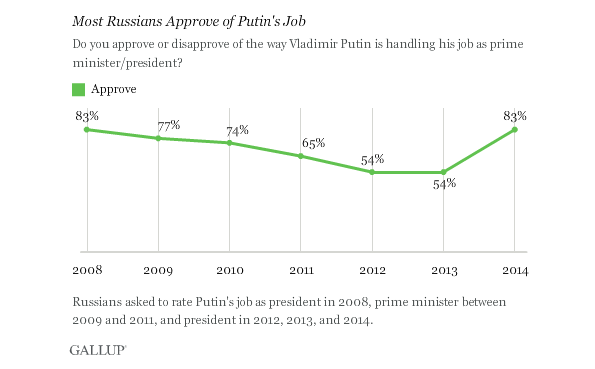
Even with the weakening of the Russian economy over the past few months, an AP/NORC poll released yesterday still finds Putin’s approval rating hovering around a whopping 80%. So he’s not only got a natural inclination to cause problems abroad to distract from problems at home, he’s also got personal experience telling him that doing so can be very successful for him from a political standpoint.
Putin, it should be noted, is already talking like a guy who has no interest in “backing down.” Yesterday he predicted that the Russian economy would be fully recovered from the current shock within 2 years. How this will happen, barring a reversal in oil prices that’s pretty much out of Putin’s hands, he didn’t say, though he did talk about the need to diversify Russia’s economy beyond energy (again, though, how you invest in diversifying the economy while that economy is at its weakest — while you’re using your government’s capital fund to bail out your banks, no less — is beyond me). On the other hand, amidst a bizarrely long riff about how the West is trying to defang the “Russian bear” and something about eating honey and berries, Putin also said that eastern Ukraine should remain part of Ukraine and even had kind words for Ukrainian President Petro Poroshenko, saying that Poroshenko wants peace but is being thwarted by other elements in the Ukrainian government (I’ll just go ahead and leave this here then). This suggests that Putin would like a way out of the current situation that lets him back down without appearing to back down. That’s why I threw in the “not without some conciliatory moves by the West” bit above, because while I think there’s almost no chance Putin just unilaterally reverses course, I also think he’d gladly accept a peaceful settlement in Ukraine and an effort at rebuilding the Russia-West relationship so long as it included some movement in Russia’s direction from Kiev and its Western backers.
I want to stipulate that the “backing down” phrasing here isn’t entirely mine although I don’t disagree with it. My view of the Russia-Ukraine conflict has been, I think, pretty nuanced, particularly when the two dominant voices in the public discourse have been either “Vladimir Putin is the devil” or “Vladimir Putin is an innocent victim of American aggression.” The West has definitely pursued a policy of containing and diminishing Russia at the cost of incorporating Russia into a collaborative diplomatic framework. It has manipulated or mishandled the situation in Ukraine at every turn in ways that have favored conflict with Moscow over peace for Ukraine and safety for Ukrainian citizens. It could be credibly argued, though I’m not buying it, that leveraging economic sanctions in order to crater the Russian economy has been the point of this entire episode from the Western perspective, that events in Ukraine were used to trigger a heavy Russian response and justify harsh economic measures to weaken Russia. I remain unimpressed with the oligarch-neoliberal-fascist coalition government in Kiev. But Putin is no innocent victim. The Crimea annexation was a pointlessly provocative effort to grab a piece of land with little strategic or economic value to Russia (don’t get me wrong, Crimea is strategically vital in the Black Sea area, but Russia already had its largest naval base there and almost certainly could have maintained it without annexing the whole peninsula). And Moscow has, in the guise of “humanitarian” concern for eastern Ukrainians, been responsible for provoking and prolonging the violence and suffering there right alongside Kiev.
So, while most of this “Russia backing down” talk is coming from outlets that are overly tilted in the “Putin is the devil” direction, there is plenty of backing down that Russia could actually do.

 The Foreign Exchanges Companion
If you have a moment to spare, google Eric Zuesse. He thinks Putin is just dreamy… and he resigned from the Democratic Party because the authoritarian neoliberals refuse to impeach bloodthirsty tyrant Obama over the torture scandals.